Hey there,
If you’ve ever spent time in a commercial kitchen or a tight-space food cart that serves giant pork meatballs—think 1-pound, 2-pound, even 3-pounders—you know there’s a quiet panic that hits halfway through cooking. Giant Pork Meatballs
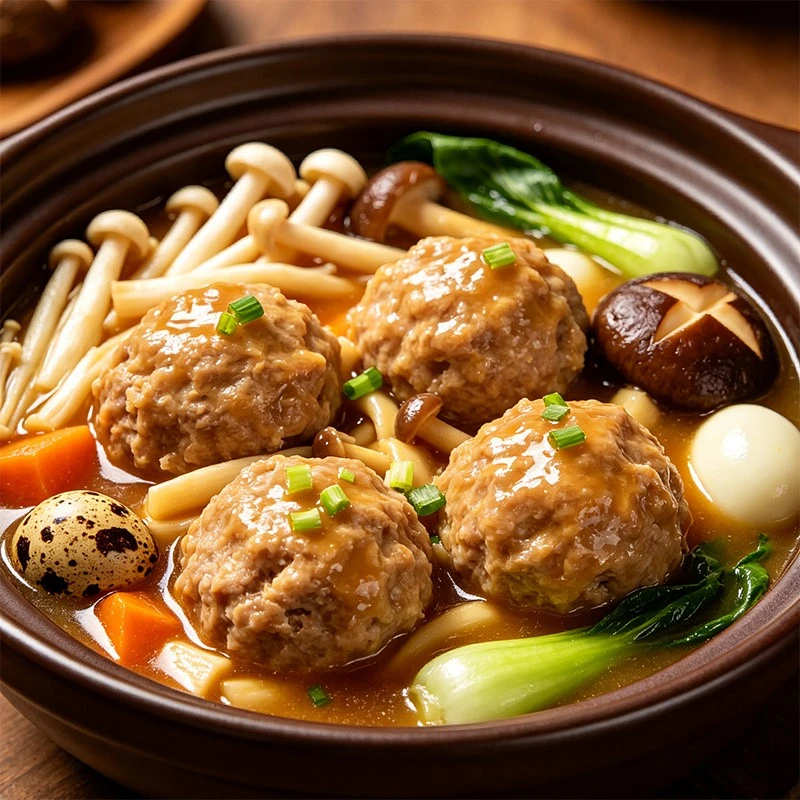
You pull the meat out of the oven, or yank the basket of a deep fryer, or lift a Dutch oven lid on the stovetop, and you’re staring at something that looks like it’s browned on the outside, juicy on top, and smells like pork. But how do you know, deep down in that thick, dense center, there’s no raw pork left?
As the owner of a pork meatball supply company that ships to food trucks, casual dining spots, and small chains across the Midwest, I’ve been asked this question by line cooks, sous chefs, and even head chefs a hundred times. It’s not just a “cook it until it feels right” trick for us—we’ve tested every method, messed up a few batches, and landed on the science that keeps our clients’ customers safe and coming back for seconds.
Let’s start with the obvious first step: raw pork’s not just “unappetizing” — it can carry trichinella, a parasite that causes trichinellosis, and salmonella, both of which can make anyone sick. For small operations, a bad meatball incident can tank a lunch service, a Yelp review, or even a health inspection. That’s why we don’t cut corners, and neither should anyone working with large-format pork meatballs.
First, let’s talk size. Most home cooks make meatballs the size of golf balls or tennis balls, but giant ones—2 pounds, say—are dense. They cook through slower than tiny ones, and the outside will get done before the inside if you’re not careful. I remember early in my company’s days, we tried to rush a batch for a pop-up food truck that needed 50 giant meatballs for a weekend event. We popped them in a 350°F oven for 45 minutes, and when a line cook cut into the first one, the center was still pale pink, oozing raw pork juice. We had to throw all 50 out, delay the delivery, and scramble to make a new batch. That mistake cost us a client for a month—and it was 100% avoidable.
So what’s the actual way to tell when a giant pork meatball is fully cooked? Let’s break down the methods we use every day, sorted by reliability.
The #1 method we trust is a meat thermometer, and not a cheap one. I see a lot of line cooks using those thin, plastic dented thermometers that are meant for grill meat, not dense, thick meatballs. For a 2-pound pork meatball, you need a thermometer that can penetrate 3 inches deep, and give you a consistent, accurate reading. Here’s the trick: stick the thermometer into the thickest part of the meatball, avoiding any bone (we don’t add bones to our giant meatballs, but some smaller makers do) and any pockets of fat. Fat can hold heat differently, so you want to get as close to the center as possible without hitting empty space. For pork, the FDA (and every food safety agency on the planet) says the internal temperature needs to hit 145°F. Wait—no, not just hit it—you have to hold that temperature for at least 3 minutes. That’s key. If your thermometer beeps at 145 and you pull it out, the core might still be a few degrees lower, and the residual heat in the meat will take a minute to catch up. We cook our giant meatballs to 150°F for 3 minutes, just to build in a little safety buffer—no one likes undercooked meat, but overcooked giant meatballs are dry, like eating a brick.
I know some people swear by the “juice runs clear” test. For a small meatball, pierce it with a fork and watch the juice—if it’s pink, it’s raw; if it’s clear, it’s done. But for a giant one? That trick doesn’t work. The outer layer might be cooked, and when you pierce it, the juice from the outer part runs clear, while the inner part is still pink. I’ve tested this on a 2-pound meatball: when the outer ½ inch was fully cooked (juice clear), the center was still at 130°F, no clear juice to speak of. So that test works for mini meatballs, but not giants—don’t rely on it.
What about the “touch test”? You know, the one where you press the meatball with your finger and compare it to the feel of your hand. Like, your palm feels like raw meat, your fingers half-bent like medium, etc. I see line cooks using this all the time, and it’s better than nothing, but it’s super inconsistent. Everyone’s fingers have different sensitivity, and giant meatballs are so dense that the outside might feel firm, while the inside is still raw. We tested this recently: three line cooks pressed the same giant meatball and all said it was done, but the thermometer read 138°F. The fourth cook, who had less calluses on his fingers, said it felt “too soft.” Again, if you use this as a backup, not your main test, it’s okay—but never trust it alone for giant pork meatballs.
Another mistake we see all the time is relying on cooking time. A 1-pound meatball takes about 60 minutes in a 350°F oven; a 2-pounder takes 90 minutes; a 3-pounder? 2 hours and 15 minutes. But those times are just guidelines. If your oven runs hot, or the meatballs are packed tight on a sheet pan, or you used lean pork instead of our standard 80/20 pork blend, that time will change. We had a client last year who baked 10 giant meatballs in a convection oven—he cranked it to 375°F to speed up service, and they only took 75 minutes, but the centers were raw. Cooking time is a good starting point, but it’s not a replacement for temperature.
Wait, what about if you’re frying or searing a giant pork meatball? We get this a lot from food trucks that deep fry their giant meatballs for tacos or sandwiches. The same temperature rule applies—insert the thermometer, get to 145°F held for 3 minutes. But with frying, the outside cooks faster, so you have to lower the heat a little after the initial sear. If you crank the fryer to 375°F, the outside will char before the inside cooks through. For frying giant pork meatballs, we recommend starting at 350°F, then dropping to 325°F once the outer layer is golden brown. That way, the heat has time to seep into the dense center without burning the outside.
We also do a lot of testing on our end to make sure our giant pork meatballs are consistent, because we don’t want our clients to have to guess. Every batch we ship is tested for internal temperature before it leaves our facility. We pull 5 meatballs from every production run, stick a calibrated thermometer into each, and confirm they hit 145°F for 3 minutes before they’re wrapped and shipped. That’s why so many of our clients—from that small taco spot in Des Moines to a casual dining chain in Chicago—come back to us. They know they can put one of our giant meatballs in the oven or fryer, hit the right temperature, and serve a safe, juicy, delicious meatball every time.
I know it’s easy to get lazy when you’re busy, when you’re running a packed lunch service, when you’re short-staffed. But with giant meatballs, cutting corners on testing internal temperature is a risk you just can’t take. A customer might get sick, and that’s a reputation killer, no matter how good your food is.
At the end of the day, the answer to “how do you know when a giant pork meatball is cooked?” is simple: use a calibrated meat thermometer, stick it into the thickest part of the meatball (avoiding fat and pockets of air), make sure it reads at least 145°F, and hold that temperature for 3 full minutes. That’s the science, that’s the safety, and that’s what keeps our clients in business and their customers happy.
If you’re a restaurant owner, food truck operator, or small chain looking for a consistent, tested giant pork meatball supply, we’re here to help. We can work with you on bulk orders, custom blends, and even delivery schedules that fit your service needs. Reach out to us to discuss your requirements and get a sample batch.
Giant Pork Meatballs References:
- U.S. Food and Drug Administration. (2023). Food Code: Part 3 – Food Service.
- National Pork Board. (2022). Pork Internal Cooking Temperatures for Food Service Operations.
- Food Safety and Inspection Service, U.S. Department of Agriculture. (2021). Meat and Poultry Cooking Guidelines for Commercial Kitchens.
Yangzhou Jingsheng Food Co., Ltd.
As one of the most professional giant pork meatballs manufacturers and suppliers in China, we’re featured by quality products and good service. Please feel free to wholesale bulk customized giant pork meatballs at competitive price from our factory. Welcome to contact us for quotation and free sample.
Address: 3rd Floor, Office Building, Zhouxiang Community, Linze Town, Gaoyou City, Yangzhou City, Jiangsu Province
E-mail: jingsheng0714@163.com
WebSite: https://www.jingshengfood.com/
