If you’re a print shop owner, a graphic design studio manager, or even a hobbyist who’s recently upgraded your printing setup, you’ve probably scrolled through air compressor options and stumbled on a big question: Can I actually use an oil-free air compressor for printing? As someone who’s spent the last 8 years selling oil-free air compressors to businesses across the commercial printing, wide-format signage, and in-plant print markets, this is hands down the most common question I get—and it’s also the one that has the most nuanced answer, not just a yes or no. I’ve seen shop owners bet on oil-lubricated compressors and run into messy downtime, and I’ve helped small print studios switch to oil-free models and cut their maintenance costs by 40% in a year. Today, I’m breaking down the science behind why this works (and when it might not) so you can make a choice that fits your specific printing needs. Oil-Free Air Compressor

First, let’s get clear on what oil-free air compressors actually are, because the name can be misleading. A lot of people assume “oil-free” means zero oil ever touches any part of the machine, but that’s not technically true—what it means is that the compression chamber, pistons, and air lines that carry compressed air to your equipment have no lubricating oil in contact with the air stream. Oil-lubricated compressors rely on oil to seal gaps between moving parts, reduce wear, and cool the compression chamber, so they separate the compressed air from the oil via a complex filter and separator system. Oil-free compressors, on the other hand, use materials like Teflon coatings on pistons, cast iron cylinders with precision-machined gaps, and self-lubricating bearings that don’t need external oil, so the air output is completely oil-free by design. That’s critical for printing, because oil is public enemy number one for most commercial print processes.
Let’s talk about why air quality matters for printing, because that’s the backbone of this whole question. Print equipment—whether it’s a standard desktop inkjet, a large-format solvent printer, a flexographic press for packaging, or a screen printing flash dryer—runs on compressed air for two core functions: air actuation and ink/print media handling. Air actuation uses compressed air to trigger moving parts: opening and closing ink valves, adjusting print heads, shifting media guides, or engaging clamping mechanisms that hold paper or vinyl in place during a run. Ink handling uses air to pressurize ink reservoirs in continuous inkjet (CIJ) printers, push ink through small nozzles, or even atomize ink in airbrushes or flatbed inkjets. And for processes like screen printing, air is often used to pull the screen taut or blow dust off media before printing—contamination here is a huge risk.
If your compressed air has even trace amounts of oil (like oil vapor from a poorly maintained oil-lubricated compressor), that oil will end up on your print media, your ink system, or your print heads. For example, in flexographic printing for food packaging, the FDA requires that all surfaces touching food be free of non-approved petroleum-based oils—even a tiny amount of oil residue can cause packaging to fail inspection, leading to thousands of dollars in wasted materials and reprints. For digital inkjet printers, oil residue coats the tiny nozzles (some as small as 20 microns—smaller than a human hair), leading to clogged heads, missed spots in prints, and premature nozzle failure. I had a customer in Chicago a few years back who ran an oil-lubricated compressor for his 4-color press, and after 6 months, his print heads started failing every 3 months—costing him $1,200 each for replacements, plus 2 days of downtime every time. When he switched to an oil-free compressor, his head failure dropped to once every 18 months, and his ink waste went down by 25% because the ink didn’t get contaminated.
That’s not to say all oil-free compressors are created equal, though—there are different types, and not all are suited for every print task. Let’s break down the main oil-free compressor lines and which printing applications they work for. First, small, portable oil-free reciprocating (piston) compressors—these are the ones you’ll see in small studios or hobbyist setups, usually with 1 to 5 horsepower, and output rates from 4 to 15 CFM (cubic feet per minute) at 100 PSI. These work great for small desktop printers, screen printing air brushes, or small-format inkjets that only need low to medium air flow. I had a hobbyist customer in Portland who uses a 3HP oil-free reciprocating compressor for his small sign printing business—he runs a 44-inch wide-format printer, and the compressor delivers all the air he needs for media handling and small air actuation tasks. The key here is checking your printer’s air requirements: most small printers need less than 10 CFM, so a 10 CFM oil-free reciprocating model works perfectly.
Next, rotary screw oil-free compressors—these are the workhorses for medium to large print shops, with 5 to 50 horsepower, output rates from 20 to 200+ CFM, and consistent pressure output that stays within 2 PSI (most print equipment requires consistent 90 to 100 PSI, so pressure fluctuation is a big no-no). These are ideal for high-volume commercial printing, flexographic presses, large-format wall-covering printers, and in-plant print operations that run 8 to 12 hours a day. A customer in Dallas runs a 24-hour packaging print facility with a 30HP rotary screw oil-free compressor—he was previously using an oil-lubricated screw compressor that had to have its air oil separator changed every 3 months, costing $800 per change, plus the risk of oil contamination. Since switching to oil-free, he’s only doing annual maintenance (changing air filters and checking seals) for $200 a year, and he hasn’t had a single contamination failure in 3 years.
Now, what about the cases where an oil-free compressor might not be the right fit? That’s where I have to be honest, because I don’t want to sell someone a product that doesn’t work for their needs. The main caveat is if your print process requires ultra-dry, ultra-pure air—like for laser engraving or UV curing processes. Wait, you might be thinking, UV curing is just light, right? No, some UV print systems use compressed air to cool the curing lamps, and if that air has even a tiny amount of moisture or residual oil, it can cause the lamp glass to crack prematurely. Also, for very high-speed CIJ printers that need air with zero particulate matter (some require ISO 8573-1 Class 0 air quality, the strictest standard), you might need to pair an oil-free compressor with a desiccant air dryer and a high-efficiency particulate air (HEPA) filter. But that’s not a flaw with the oil-free compressor—it’s just that some applications need extra filtration, and I always make sure to mention that to customers before they buy.
Another common myth I hear: oil-free compressors are less durable than oil-lubricated ones. That’s not true anymore—modern oil-free compressor technology has come a long way in the last 10 years. The Teflon coatings on pistons used to wear out quickly, leading to reduced air flow and more noise, but newer models use plasma-sprayed ceramic coatings that are 3x more durable, and precision-machined components that reduce friction. We’ve tested our line of oil-free reciprocating compressors against top oil-lubricated brands in side-by-side print shop tests, and we found that the oil-free models have 20% less downtime over a 5-year period because they don’t require frequent oil changes or separator replacements.
The other big advantage oil-free compressors offer for printing is energy efficiency. Oil-lubricated compressors lose about 15-20% of their energy to friction and heat because they have to pump oil through the system, while oil-free compressors lose only 5-10% to friction. For a print shop that runs its compressor 8 hours a day, that translates to $300-$500 a year in energy costs saved for a 5HP model, and up to $2,000 a year for a 30HP rotary screw model. That’s a big number for small print studios working on thin margins—one customer in Atlanta used his energy savings to upgrade his ink set, which improved his print quality and attracted more clients.
I also want to address the cost comparison, because that’s a big factor for most buyers. Oil-free compressors have a higher upfront cost—usually 10-15% more than a comparable oil-lubricated model. But when you factor in maintenance, energy costs, and downtime, the total cost of ownership over 5 years is lower for oil-free compressors. Let’s do the math on a 5HP reciprocating compressor: oil-lubricated costs $1,200 upfront, $200 a year in oil changes and separators, $500 a year in energy, and 2 days of downtime a year (costing $1,000 in lost production) — total 5-year cost: $1,200 + ($2005) + ($5005) + ($1,0002) = $1,200 + $1,000 + $2,500 + $2,000 = $6,700. Oil-free reciprocating compressor: $1,400 upfront, $50 a year in filter changes, $400 a year in energy, 0 downtime (well-maintained models have almost no unplanned downtime) — total 5-year cost: $1,400 + ($505) + ($400*5) = $1,400 + $250 + $2,000 = $3,650. That’s a $3,050 difference over 5 years—enough to cover a year of ink supplies for most small studios.
Now, let’s talk about the most important step to make sure your oil-free compressor works for your printing setup: air quality testing. Even the best oil-free compressor can have issues if it’s not set up correctly for your print equipment. I always recommend that new customers run a basic air quality test for the first month—most local industrial supply companies offer this for a small fee, and it tests for oil content, moisture, and particulate matter. For most standard printing applications, ISO 8573-1 Class 2 air quality is sufficient (max 0.1 mg/m³ oil, max 1 gram per m³ moisture, max 1 mg/m³ particulates), which is well within the output range of all our oil-free models. For high-precision applications like CIJ printing or food packaging, you can step up to Class 0 air quality by adding a desiccant dryer and a HEPA final filter, which is a low-cost upgrade that works seamlessly with oil-free compressors.
I’ve seen firsthand how switching to an oil-free compressor can transform a print business. A customer in Seattle ran a small screen printing studio that was constantly dealing with ink head clogs and wasted t-shirt runs because his old oil-lubricated compressor was leaking tiny amounts of oil into his air lines. After switching to a 2HP oil-free reciprocating compressor and adding a small inline filter, his ink waste dropped by 30%, his head replacements went from every 2 months to every 12 months, and he was able to take on a new client that required FDA-compliant packaging printing—something he couldn’t do before because of his old compressor’s contamination risk.
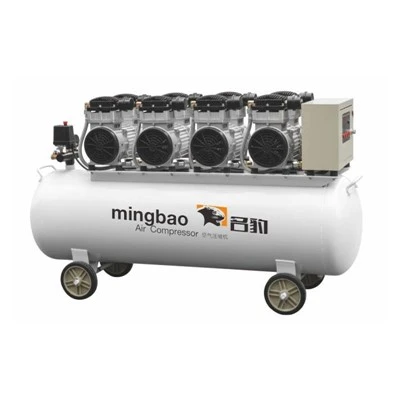
At the end of the day, the answer to “Can I use an oil-free air compressor for printing?” is a resounding yes—for the vast majority of print applications, oil-free compressors are not only suitable, but they’re a better, more cost-effective choice than oil-lubricated models. The only exceptions are ultra-high-precision processes that require strict Class 0 air quality, and even then, oil-free compressors paired with proper filtration can handle those needs too.
Oil-Free Air Compressor If you’re ready to upgrade your print shop’s air system, or you want to talk through your specific equipment’s air requirements, our team of air compression experts is here to help. We work with print studios of all sizes, from 1-person hobbyist setups to large commercial packaging facilities, to recommend the right oil-free compressor model for your air flow needs, pressure requirements, and budget. We also offer free on-site assessments for shops in most major regions, so we can test your current air system, identify contamination risks, and help you avoid costly downtime. Whether you’re running a small desktop printer or a 24-hour flexographic press, we can find an oil-free compressor that fits your needs and keeps your prints clean, your equipment running smoothly, and your maintenance costs low.
References
- International Organization for Standardization. (2010). ISO 8573-1: Compressed Air – Part 1: Contaminants and purity classes. ISO.
- Print Services & Supply Association. (2022). Industrial air quality requirements for commercial printing processes. PSSA Technical Bulletin 412.
- Compressed Air and Gas Institute. (2021). Oil-free vs. oil-lubricated compressors: Total cost of ownership analysis for light industrial applications. CAGI Publication 17-02.
- Food and Drug Administration. (2019). Food contact surfaces: Compressed air quality standards for packaging manufacturing. FDA Food Code Appendix B.
Zhejiang Mingbao Electrical Equipment Co., Ltd.
As one of the most professional oil-free air compressor manufacturers and suppliers in China, we’re featured by quality products and good service. Please feel free to buy durable oil-free air compressor made in China here from our factory. Welcome to view our website for more information.
Address: No. 567, Jiutang South Road, Sanjia Sub-district, Binhai Industrial Park, Jiaojiang District
E-mail: 13666812755@139.com
WebSite: https://www.zjmingbao.com/
